
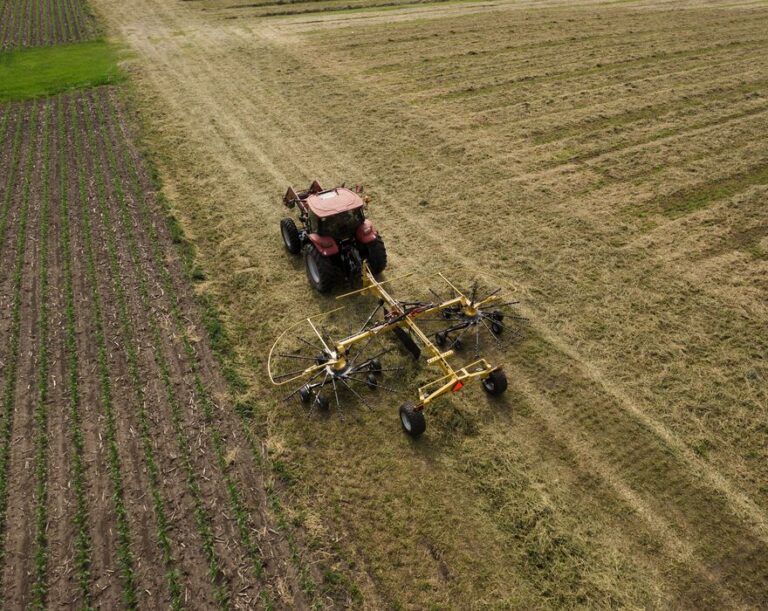
Rotary rake best practices for quality haymaking
April 2026
The better you rake, the better your forage.
That’s why choosing the best rake for the job is critical to quality hay production.
While Vermeer offers top-of-the-line hay rakes for every operation, more producers are turning to rotary rakes as the demand for high-quality forage increases. Their efficient design delivers fluffy, even windrows and minimizes dirt and rock contamination for a cleaner product that commands top dollar.
Below, we’ll help producers large and small understand the benefits of rotary rakes, and get rotary rake best practices and maintenance advice that separates good hay from premium hay. From pre-season preparation to daily operation and annual maintenance, you’ll have what you need to get the most out of your rotary rake.
Key considerations for successful hay raking
Every operation has varying acreage, terrain, crop types and tractor size. To select the best rake for your forage needs, consider:
- Field size and shape: Larger, open fields require models that can cover more ground in fewer passes and deliver windrows to the center, reducing your harvest time. Navigating tight corners, irregular fields and odd-shaped sections is much easier with single-rotor models.
- Tractor horsepower: You’ll want to match rake capacity to available power. A small utility tractor won’t handle a twin rotary rake efficiently, while an oversized tractor pulling a small rake wastes fuel and time. Most single-rotor models need 25 hp – 35 hp (18 kW – 26 kW), while larger tandem rakes require 50+ hp (36.8+ kW) to operate smoothly.
- Crop types: Heavy alfalfa first-cutting requires adequate PTO power and may slow your ground speed, but any properly sized rotary rake can handle it. The key is matching your rake’s working width to your tractor’s horsepower. A wider rake on an underpowered tractor will struggle in heavy crops, and lighter crops like grass hay offer more flexibility in rake sizing.
- Storage and transport: Single rotary rakes might take up less space in your barn, but twin rotary rakes with cart mounting offer easier transport. They fold and unfold hydraulically and feature larger transport tires for long-distance moves.
The good news is, rotary rakes come in a variety of sizes to fit your needs. These rakes are easily maneuverable and closely follow changing field contours for clean raking. Their efficient design ensures quality performance across crop types.
- Reach out to your Vermeer hay equipment dealer to purchase your next rotary rake
The advantages of rotary rakes
Whether you’re preparing windrows for dry hay baling or for chopping into silage, rotary rakes deliver quality results. Rotary rakes use spinning rotors with multiple tine arms to gently lift and sweep hay into fluffy, even windrows. And unlike wheel or basket rakes, rotary rakes run off the tractor’s PTO, so they produce consistently in different crop conditions and at different speeds.
This design gives you:
- Higher-quality forage: PTO-driven rotary rakes don’t rely on ground contact to turn, ; the tines gently lift the crop, preventing rocks, dirt and ash from contaminating the windrow.
- Faster drying: The spinning, lift-and-drop action creates a loose, fluffy windrow, allowing for air circulation, which reduces drying time compared to wheel or basket rakes.
- Consistent windrows: Rotary rakes produce uniform, consistent windrows, which allow balers and choppers to run faster and more efficiently.
- Versatility across conditions: Rotary rakes are better suited for handling heavy or wet forage, making them ideal for silage or baleage, whether you’re baling or chopping.
- Reduced leaf loss: By handling hay gently, rotary rakes retain more leaves, which is crucial for high-quality crops like alfalfa.
Rotary rake maintenance: How to prep for consistent raking
Rotary rakes do have more moving parts than wheel rakes and hydraulic bar rakes, but the well-designed Vermeer models are built for straightforward maintenance routines.
Rotary rakes run on sealed bearings and gearboxes designed to stay clean, while wheel rakes rely on ground-driven tines that contact the soil. Both designs are durable, but rotary rakes eliminate some of the wear associated with constant ground contact. Most rotary rake maintenance comes down to basic lubrication and visual inspections, tasks that take minutes, not hours. Here’s what that looks like.
Before the first cutting
If your rake has been in storage, you’ll want to complete a thorough inspection at least two weeks before the first cut. Some essential checks:
- Structural inspection: Walk the machine looking for bent tines, damaged rotor arms, loose hardware and cam track wear or debris. You’ll also want to check the frame for stress cracks at welds and mounting brackets and verify all safety shields and guards are secure.
- Hydraulic system: Be sure to check cylinders and hoses for leaks, cracks, or weather damage, and top off with manufacturer-recommended fluids.
- Drive system: Inspect the PTO shaft for damaged shields, excessive play or worn joints. Check for grease leakage and verify the slip clutch functions properly at the correct torque.
- Gearboxes and bearings: Check oil levels, look for leaks around seals and spin rotors by hand (with PTO disconnected) to listen for bearing noise.
- Tires and axles: Check tire pressure and inspect for cuts, cracking or uneven wear. On walking tandem systems, verify pivot points move freely and are lubricated. Check wheel bearings by rocking each tire and tighten as needed.
- Lubrication: Grease all fittings until fresh grease purges from bearings, hitting all rotor arm pivots, cam tracks, chain drives, transport axle pivots and fold-up mechanisms.
Daily rotary rake maintenance
At the end of each day:
- Grease all main bearings and rotor pivots
- Remove any crop material wrapped around rotors or caught in mechanisms
- Check for loose or missing bolts, especially on tine arms
- Look for damaged tines and replace immediately to prevent unbalanced rotors
Time required: 10 – 15 minutes
Weekly rotary rake maintenance
Once per week during active use:
- Grease all fittings thoroughly, including those not on the daily list
- Check gearbox oil levels
- Inspect hydraulic hoses for leaks or damage
- Tighten all hardware, working systematically around the machine
- Check tire pressure with a gauge
- Check tine arm tightness on mounting bolts
Time required: 30 – 45 minutes
Monthly rotary rake maintenance
Once per month:
- Check all shields, guards and hardware for security; tighten loose parts and replace worn or missing components
- Inspect hydraulic system for leaks, kinked hoses or parts rubbing together
- Inspect and clean all safety signs and replace any that are damaged or missing
- Inspect frame for bends, cracks or breaks
- Check windrow curtain for holes, tears or excessive bottom wear
- Inspect reflectors and replace any missing or damaged materials
- Grease frame steering, steering hitch axle, steering front and rear axles, and wheel steering axle
- Grease rotor drive shafts, pinion and ring gears, tine arm bushings and curves on each rotor
Time required: 1 – 2 hours
Annual rotary rake maintenance
Before storage or at season’s end:
- Complete gearbox oil change on all gearboxes
- Thoroughly clean the entire machine, removing all crop residue
- Inspect and replace worn bearings
- Check all structural components for fatigue or damage
- Replace any marginal tines or hardware before storage
- Apply rust preventive to exposed metal surfaces
- Park on level ground with rotors raised to prevent flat-spotting tires
- Store indoors if possible, or cover securely with weatherproof material
Time required: 3 – 4 hours
Rotary rake best practices: Adjusting to your field conditions
Different field conditions and crop types require different rake settings. Here are several rotary rake best practices to optimize performance for your specific setup.
Set the proper tine height
Tine height is the most critical consideration for quality forage. Too low, and you’ll push dirt into windrows and risk tine damage. Too high, and you’ll leave forage behind. Alfalfa raking typically requires tine heights of 1 in – 1.5 in (2.5 cm – 3.8 cm) above ground, but tine-to-ground clearance should be adjusted based on crop stubble height and ground roughness.
After making your adjustments, be sure to check windrows for ground cleaning effectiveness and soil contamination, then fine-tune. The goal is to let tines sweep the crop without dragging on the ground. Walk behind your rake for the first few passes and watch how tines interact with the windrow.
Adjust the rotor curve for better windrows
Beyond tine height, rotor curve adjustment (sometimes called cam timing) plays a crucial role in windrow quality. This setting controls how soon the crop is released to the windrow, which directly affects windrow shape and consistency. On Vermeer rotary rakes, this adjustment is exceptionally easy. Simply move a lever between five different settings with the tool-free design to fine-tune performance on the fly as conditions change.
Apply the appropriate rotor speed and PTO rpm
You’ll want to use the slowest PTO speed possible while still maintaining acceptable crop gathering and windrow forming performance. Most rotary rakes operate at 450-500 PTO speed, but optimum ground speed will depend on crop being raked, terrain and tractor power. Reduced ground speed may be necessary for hills or rough terrain. Avoid rough or uneven terrain which could lead to tractor tipping or rollover. Maximum allowable operating ground speed is 7.7 mph (12.5 km/h). Do not exceed this operating speed in any condition, and never exceed 540 PTO rpm.
If windrows appear flat or compressed rather than fluffy, you’re likely moving too fast for the conditions.
Set the windrow width
Your windrow width should match your equipment’s needs, whether that’s your baler’s pickup width or your chopper’s requirements. Windrow width adjustment is done by moving the rotors in and out on center-delivery models or adjusting the curtain position on side-delivery models. Narrow windrows of 3 ft to 4 ft (0.9 m – 1.2 m) work well for smaller balers and can be helpful when first-cut volume is heavy and you need better crop distribution. Wide windrows of 5 ft to 6 ft (1.5 m – 1.8 m) are better suited for high-capacity balers and reduce the number of passes you’ll need to make across the field.
The key is matching windrow width to your harvest equipment for efficient pickup and consistent results.
Adapt to the terrain
We already mentioned increasing the tine height in uneven fields to prevent ground contact on low spots, but you might consider a rotary rake with walking tandem axles to help maintain consistent tine height on rough ground. Rolling hills require slower speeds on slopes to maintain tine contact. If possible, consider working across these slopes rather than up and down so your tines don’t lift off the ground as much. For terraced fields, try to work with terraces instead of across them. Be extra cautious with tine height changes at terrace edges, and consider hand-raking terrace edges if necessary for clean forage.
Time your raking right
The best times to rake are early morning (after dew dries but before peak heat), in the late afternoon or early evening as temperatures drop, and when relative humidity is 40% – 60%. Try to avoid raking when crop moisture is below 15% (excessive leaf loss risk), during peak afternoon heat, or immediately after a heavy dew, which tends to create roping.
When working multiple fields, start with fields that were cut earliest, and prioritize well-drained and sunny fields that dry faster. Save shaded or slow-drying fields for later in the day. It might help to keep a field log noting cut date, weather conditions, and rake timing.
Common issues in hay raking, and how to solve them
Even with proper rotary rake maintenance and adjustments, you may run into inconsistencies with your output. Here’s how to diagnose and solve the most common hay raking challenges.
Windrows aren’t fluffy
Possible causes:
- Ground speed too fast for conditions
- Tines worn down, reducing their ability to lift crop
- PTO speed too low
- Crop too dry and brittle
Solutions:
- Reduce ground speed by 1 – 2 mph
- Replace worn tine arms
- Check tractor PTO speed with a tachometer
- Rake earlier in the day when moisture content is slightly higher
Excessive leaf loss
Possible causes:
- The crop is too dry
- PTO speed too fast
- Tines are set too low
- Raking during heat of day
Solutions:
- Rake in early morning or evening when relative humidity is higher
- Reduce ground speed
- Raise tines 1 in – 2 in (2.5 cm – 5.1 cm)
Uneven windrow formation
Possible causes:
- Uneven rotor speed, which could be a mechanical issue
- Bent or missing tine arms creating imbalance
- One rotor dragging due to bearing failure
- Uneven ground speed
Solutions:
- Check for bent tines and replace immediately. Even one bent tine can throw off the entire rotor balance.
- Listen for bearing noise while rotors spin
- Inspect cam track for debris or damage
- Maintain consistent ground speed using tractor throttle lock
Dirt or rocks in windrows
Possible causes:
- Tines set too low
- Tractor bouncing due to excessive speed
- Field damaged by previous operations
Solutions:
- Raise tine height to reduce contamination
- Reduce ground speed over rough areas
- Consider equipping rakes with walking tandem wheels
- Accept higher tine settings and slight crop loss on very rough fields
Excessive tine wear
Possible causes:
- Tines running too low
- Operating on abrasive soil types
- Rocks or debris in field
- Poor field surface from mowing or previous operations
Solutions:
- Raise tine height to minimize ground contact
- Avoid rocks and debris when possible
- Consider field grooming or dragging before harvest season
- Budget for more frequent tine replacement on sandy or volcanic soils
Get high-quality rotary rakes from Vermeer
Vermeer’s rotary rake lineup features smart, durable design using premium materials that can deliver premium forage in the most demanding operations. These hassle-free rakes can quickly adapt on the fly and deliver clean, high-quality windrows acre after acre.
Vermeer RR140s rotary rake
The Vermeer RR140s rotary rake delivers excellent maneuverability for small-to midsized operations, making it ideal for fields with irregular shapes or tight end rows. This single-rotor, side-delivery rake features 12 tine arms (each with four double tines), a strong modular rotor, two walking tandems, and large 16.5-in (42-cm) cam tracks. With toolless adjustments and a 14.1-ft (4.3-m) raking width, the RR140s requires a minimum 27-hp (20.1-kW) tractor.
The RR140s offers:
- Two patented walking tandem axles that maintain consistent tine height on uneven ground, preventing the dirt contamination and uneven windrows that plague operations on rough terrain.
- Tool-free adjustments so you can adapt to excessive leaf loss or dirt pickup quickly without heading back to the shop.
- Large cam tracks that operate smoothly, reducing wear and minimizing mechanical issues that cause uneven windrow formation.
- Modular rotor design so when you do hit that hidden rock, individual sections can be replaced without removing the entire unit, allowing you to get back to work faster.
Vermeer RR270c rotary rake
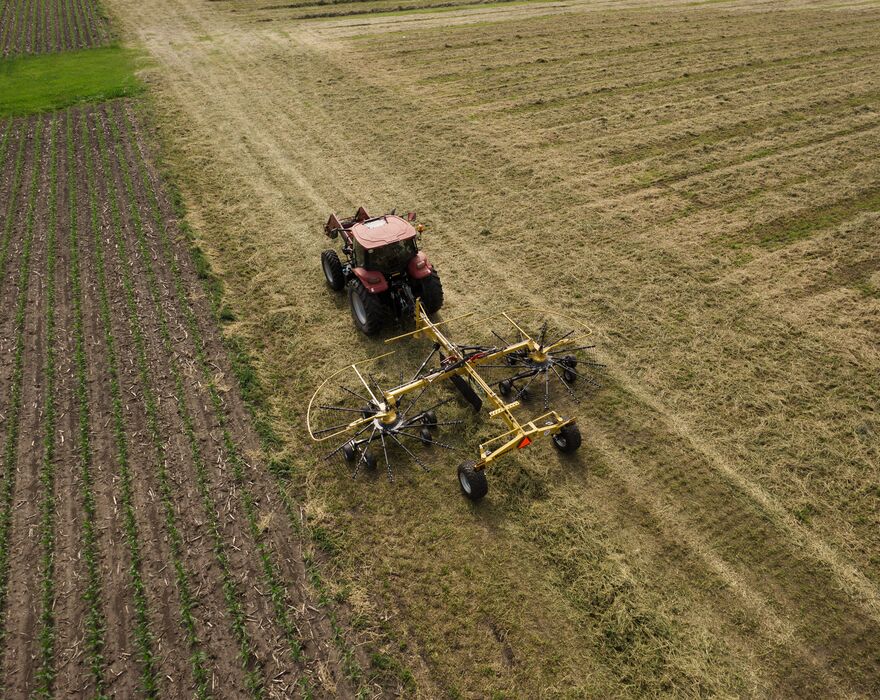
For high-capacity raking, the Vermeer RR270c rotary rake allows you to do more in a day without sacrificing hay quality. The twin-rotor, center-delivery rake is built for larger operations needing wider raking widths of 23.7 ft to 27.2 ft (7.2 m to 8.3 m) and maximum efficiency, even in heavy first-cut conditions. Its modular rotor design features three walking tandems per rotor (each equipped with 13 tine arms and four double tines) and a steerable axle for improved maneuverability. The cart-mounted rake requires a minimum 55-hp (41-kW) tractor.
The RR270c offers:
- Three patented walking tandems per rotor that excel in rough terrain, maintaining the consistent ground contact that prevents both dirt pickup in low spots and forage loss on high ground.
- Steerable axle that improves maneuverability even with the wider working width, making it easier to navigate field edges and obstacles without compromising windrow quality.
- Modular rotor design that reduces downtime when tine damage occurs because you can replace individual sections instead of the entire rotor.
- Heavy-duty construction that stands up to years of demanding use, with reinforced high-stress areas that typically fail first on other rakes.
Choose the best rotary rake for your operation
The right rotary rake depends on your fields, tractor, and crops. Larger, open fields benefit from the Vermeer RR270c’s tandem rotors and center delivery, which cover more ground in fewer passes. Smaller operations or those working irregular fields will appreciate the RR140s’s maneuverability and simpler logistics.
The RR140s works with smaller tractors starting at 27 hp (20.1 kW), while the RR270c needs at least 55 hp (40.5 kW) to handle its higher capacity, which makes it ideal for heavy alfalfa’s first-cutting that would overwhelm a single-rotor model.
Explore the complete Vermeer rotary rake lineup, or reach out to your local hay and forage dealer, who can walk you through your operation’s unique demands and recommend the best fit.