
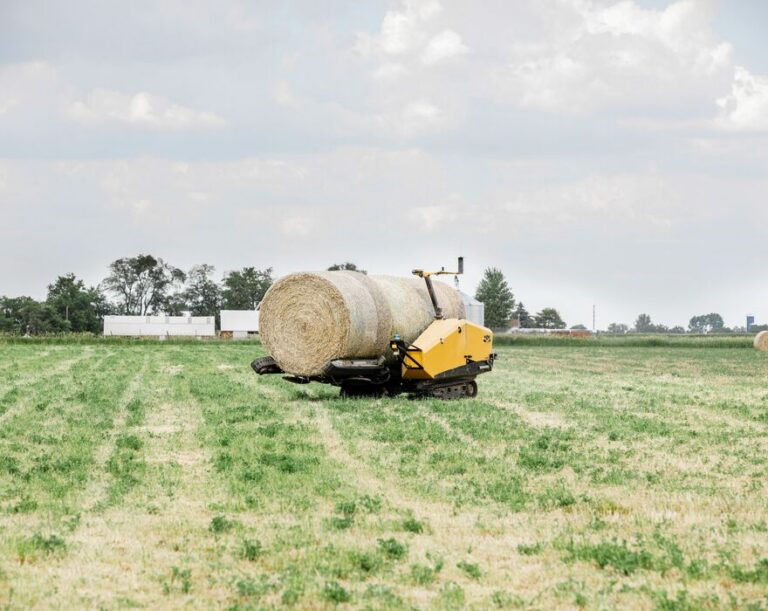
Balehawk autonomous bale mover prototype: Your questions, answered
August 2026
You’re asking the right questions. So are we.
The footage lasts just a few minutes. An autonomous machine, blinking in the dark of the night, moves round hay bales across a Nebraska field on its own. No operator. No tractor.
That machine is the Balehawk® bale mover. This first-of-its-kind autonomous bale mover from Vermeer is being tested to locate, collect and move round bales within a geofenced field without an onboard operator.
The views piled up, totaling more than 30,000 in about a month. The comment section was peppered with question after question.
How fast can it go?
What about hills and tough terrain?
How does it handle wet weather?
What about bales wrapped in twine instead of netwrap?
What’s the price?
And of course …
When can I get one?
These are questions hay producers ask because they know an eye-catching video online is different from crunch time during the height of hay season.
Here’s the thing: Vermeer has been listening to those questions and asking more of its own while engineering and rigorously testing Balehawk. That’s the point of a prototype.
What is the Vermeer Balehawk autonomous bale mover prototype?
Balehawk, which began as an idea from the Vermeer Forage Innovations group more than a decade ago, is an autonomous bale mover currently in prototype testing. It’s designed to move round bales without an operator at an automated speed up to 5 mph (8 km/hr). It navigates the field on tracks and locates bales within a predetermined digital geofence before transporting them to a selected staging area.
Balehawk is built to carry the two most common round bale sizes in North America: 4-ft-wide and 5-ft-wide (1.2-m and 1.5-m) bales. Designed for producers who put up several thousands of bales per season, Balehawk makes collection less of a chore while removing an operational bottleneck.
Balehawk is not yet a finished commercial product. Final specifications, pricing and production timeline have not yet been announced. Prototype testing is how a concept gets stress-tested against reality before any of those decisions are made. Balehawk is in that phase now, being put through its paces in real field conditions so Vermeer can learn what works, and what needs to be strengthened.
This hay season, select Vermeer customers are working closely alongside Vermeer to put Balehawk to work in multiple states.
Why is Vermeer testing autonomous bale moving?
The Vermeer Forage Product Engineering team takes a thorough approach to product development. Before an idea moves toward commercial development, it gets extensive testing in fields — different terrains, different conditions, different workflows, different operators. The prototype phase is the hardest part of the process. By design.
Bryce Heitman, senior project engineer, says this philosophy thrives at Vermeer because many on the team farm themselves and speak daily with others who do the same.
“Our customers articulate pain points and we often feel them ourselves,” Heitman said. “That’s where our skill set comes in — understanding those pain points and thinking there has to be a better way to do this. The goal is to come up with an idea that solves it.”
Post-baling logistics are that kind of pain point. Moving bales after the baler passes through is one of the most time-consuming parts of a hay operation. Labor can be hard to find. Hay windows don’t wait. Automating the task helps producers take on additional work — or take some time back for themselves and their loved ones.
“If you want the bales off as fast as possible, it’s true that you may be able to do it faster with several people and several pieces of equipment,” Heitman said. “But I can wash my dishes faster by hand than by using my dishwasher. I’d rather use my dishwasher and go do something else than wash dishes. With Balehawk, you can go do something else, like possibly take on more baling customers.”
For Balehawk, the path from concept to production-ready runs through every hard question the comment section asks — and then some.
What field conditions is Balehawk being tested in?
Balehawk prototype testing process isn’t a single pass. It’s an iterative cycle: run the machine, observe what happens, identify potential failure points, adjust and run it again.
The goal? Find potential problems and fix them before a hay producer encounters them.
“We’re constantly wanting to put Balehawk into conditions that are going to be difficult so we can see machine behavior and figure out how we can handle those situations,” Heitman said. “Mechanical failure in prototype testing is a great thing, because we can make the machine stronger and make sure that when it’s unsupervised, we’re not going to have that situation.”
Prototype testing has produced advancements in the following areas:
- Balehawk can navigate slopes of about 7 degrees without issue, a threshold set to prevent bales from tipping or rolling off the machine. Pushing that limit higher is an active area of development, addressed through both software refinement and mechanical changes. One visible example added from the prototype testing process: a curved shield along the rack that was added specifically to keep bales on the machine when operating on slopes.
- Ground conditions have been another proving ground. The team has run the prototype through cornstalk fields — as rough a surface as a field is likely to offer — and through the soft soils of Nebraska’s Sandhills, where some machines struggle after rain or in sandy conditions. Balehawk’s track system handles both scenarios in various weather scenarios better than a wheeled alternative would.
- Netwrap has been the primary focus of testing, and it’s preferred for use with Balehawk because it wraps the bale tightly, producing a clean, consistent cylinder that’s predictable for the machine to handle. Twine-wrapped bales are also supported, but Heitman notes hay that pokes out from bales wrapped in this method can produce unpredictability during automated retrieval.
How Balehawk works in the field
Balehawk is designed to run largely unsupervised. The setup is handled from the cab of a vehicle, not from the machine.
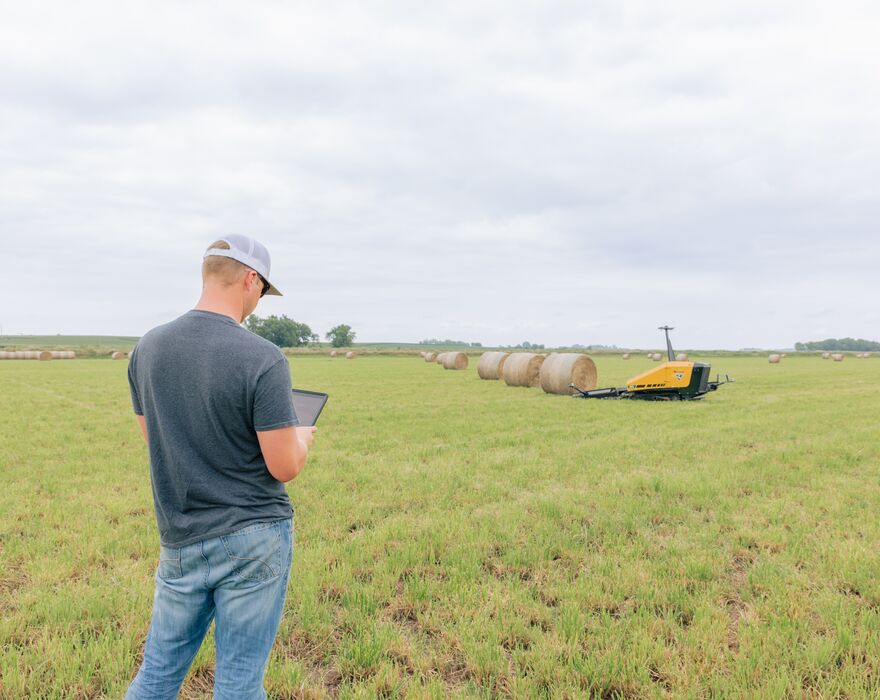
Using an app, the operator draws a digital geofence around the field, selects the bale size being worked and designates where the stack line should go. That’s the main operator input. Balehawk takes care of everything else.
Before the job launches, the app calculates a zigzag search path across the geofenced area and displays it on the tablet. Balehawk works that path systematically, locating and collecting bales until every row has been covered. When it completes the path, the job is done.
High-accuracy global positioning system (GPS) technology runs on both the machine and the tablet, and the combination ensures Balehawk stays inside the boundary the operator sets. The machine handles ruts and uneven terrain without operator correction — an advantage of the track system and the autonomy platform the team continues to refine.
What comes next
Testing, testing and more testing.
Balehawk is hard at work with select customers this hay season, a critical step in moving from controlled prototype testing toward production operation. While working closely with Vermeer, these customers will handle field setup and job launch. After that, Balehawk largely runs on its own.
The work being done now — the iteration, the adjustment, the field hours — will shape the final path toward production.
Vermeer Balehawk FAQ
Balehawk has generated plenty of curiosity — and plenty of practical questions from producers who know bale moving is only simple until the weather turns, labor gets tight or the field conditions change.
This FAQ answers common questions about what Balehawk is, how it works, what Vermeer is testing and what is still being determined. Because Balehawk is a prototype, final specifications, pricing and production timing have not been announced.
What is Balehawk?
Balehawk is an autonomous bale mover prototype developed and tested through the Vermeer Forage Innovations group. It operates on tracks, moves bales at a speed up to 5 mph (8.05 km/hr) and navigates using a geofenced boundary set by the user on a tablet app.
As a prototype, Balehawk is not a finished commercial product. Final specifications, pricing and production timing have not been determined.
Why is Vermeer exploring autonomous bale moving?
Balehawk optimizes autonomy to help producers manage bale-moving logistics when labor is limited and timing matters. It’s part of Vermeer’s broader forage innovation work — listening to producer pain points and exploring whether there’s a better way to address them.
What does “prototype” mean?
A prototype is a working concept used to evaluate whether an idea can become a field-ready solution. Balehawk is a prototype, which means it is not a finished commercial product. Specs, features, availability and timing are not final. Testing is ongoing as select producers who are working closely alongside Vermeer put Balehawk to work in their field this hay season.
Who is Balehawk designed for?
Hay producers who put up several thousands of bales per season, where bale collection can become a significant operational bottleneck. The machine specializes in 4-ft-wide and 5-ft-wide (1.2-m and 1.5-m) round bales, the two most common sizes in North America.
Is Balehawk a finished product?
No. Balehawk is a prototype under active testing and development. There is currently no commercial availability; final specifications and pricing have not been announced. The prototype phase is how Vermeer evaluates whether and how a concept can become a field-ready solution.
When will Balehawk be available to purchase?
Vermeer will be testing Balehawk with select customers in multiple states this hay season. No broader production timeline or pricing has been announced.
How does Balehawk affect the field?
Balehawk runs on tracks rather than wheels. Track systems distribute weight across a larger surface area than tires, which can reduce ground disturbance in soft or wet conditions. How Balehawk’s track system specifically performs across different soil types, field conditions and turning scenarios is part of active prototype testing. No confirmed specifications on field impact have been announced.
Will Balehawk work on hills and uneven terrain?
Balehawk handles slopes up to 7 degrees while preventing bales from rolling and tipping. The Vermeer engineering team is actively working to expand that threshold through software and mechanical refinement. One step forward added through prototype testing was a curved side shield that keeps bales on the machine at higher side slopes. The track system handles ruts, ditches and uneven field surfaces better than a wheel-based alternative.
Does it work with netwrap and twine?
Netwrap is the primary focus of testing and produces the most consistent results — a tightly wrapped bale provides a clean, predictable surface for the machine to handle. Twine-wrapped bales are supported, but with more variability.
What about soft ground or wet conditions?
Balehawk’s track system is an advantage in soft and wet ground. Tracks performed well in cornstalk fields and the soft soils of Nebraska’s Sandhills and after rain, where wheel machines often struggle for traction and ground bearing. Soft, wet and frozen ground conditions are part of the active testing program.
Does it work on cornstalk or straw bales?
Cornstalk fields in various weather conditions have been a deliberate part of the testing program — among the roughest surfaces the prototype can be put through. Varied bale types and residue conditions are part of the iterative testing cycle.
What are the bale spacing requirements?
Balehawk’s geofencing and search path system is designed to locate bales wherever they land in the field, accounting for the natural variation in spacing that occurs during real production baling.
How do I set it up and operate it?
Setup is handled from a vehicle using a dedicated app. The operator creates a digital geofence around the field, selects the bale size and designates the stack line location. The app then calculates a zigzag search path. Once launched, Balehawk works the path autonomously. High-accuracy GPS on both the machine and the tablet keeps it inside the defined boundary.
How much will it cost?
No pricing has been announced. Pricing decisions come later in the development process.
How can producers share feedback or stay updated?
Field reports and development updates will be shared as testing progresses. Questions and feedback are welcome — contact your local Vermeer dealer or reach out through vermeer.com.
Vermeer Corporation reserves the right to make changes in engineering, design and specifications; add improvements; or discontinue manufacturing at any time without notice or obligation.
Equipment shown is for illustrative purposes only and may display optional accessories or components specific to their global region.
Please contact your local Vermeer dealer for more information on machine specifications.
Vermeer, the Vermeer logo, Equipped to Do More, and Balehawk are trademarks of Vermeer Manufacturing Company in the U.S. and/or other countries.
© 2026 Vermeer Corporation. All Rights Reserved.