
How to set up 604 S-series balers before heading to the field
November 2026
A few minutes spent on round baler setup can help establish the foundation for a successful day in the field. Proper setup can help operators make more consistent bales, optimize netwrap performance and get the most from their equipment as conditions change.
From pickup height to net tension, getting your 604 S-series balers dialed in starts long before the first bale is formed.
Use these best practices to help prepare your baler for a productive day in the field.
What should be included in your 604S baler setup checklist?
Before heading to the field, take a few minutes to make sure the baler and tractor are properly connected and configured.
Start by checking:
- Electrical harness connections
- Hydraulic hose routing
- Direct battery connection for the tractor harness
- PTO speed selection
- Hitch height settings
- Monitor placement inside the cab
“Make sure all your hoses and harnesses are tied up really well and that your tractor harness is hooked directly to the battery,” said Kent Recker, senior project engineer for Vermeer.
He also recommends ensuring the monitor is positioned where operators can easily see alerts, access controls and hear system notifications while baling.
Next, verify your tractor is set to the correct PTO speed and inspect hitch height settings to ensure they align with the machine’s specifications. Proper setup at the tractor can help establish a solid foundation for the rest of the baler’s performance.
What is the correct pickup height on a 604 S-series round baler?
Pickup height is one of the first adjustments operators should make when preparing a baler. Recker recommends starting with the pickup tooth approximately 1.5 in (3.81 cm) above the ground.
“We’ll use something like a 2 by 4, set it on the ground on concrete and then adjust your gauge wheels,” Recker said.
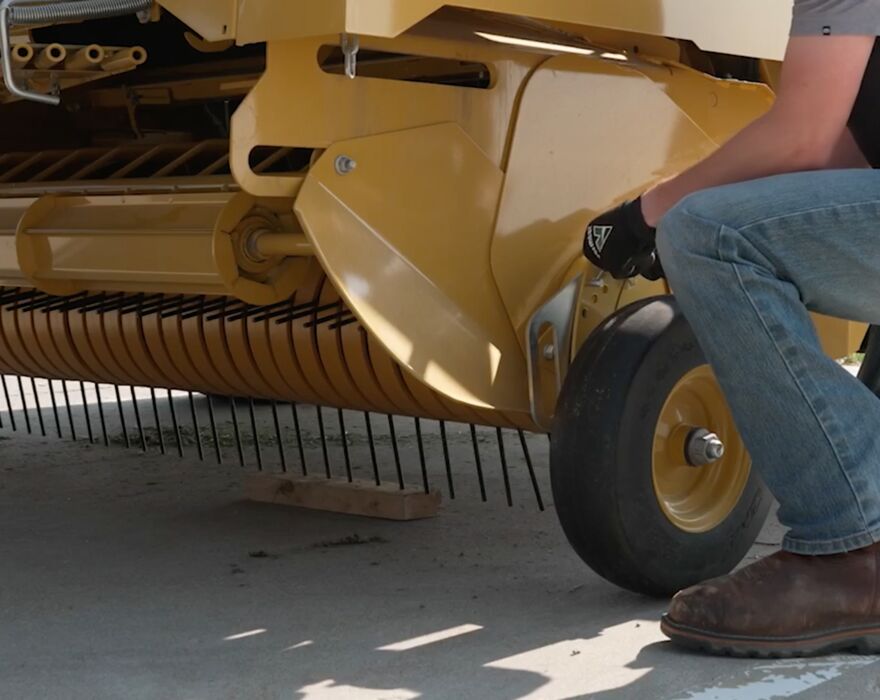
While the exact setting may vary depending on crop type, windrow condition and field conditions, the 2×4 method provides a consistent starting point.
Once in the field, operators can fine-tune pickup height based on:
- Crop type
- Field conditions
- Windrow consistency
Why should you inspect the baler while it’s still clean?
Inspecting your machine when you first get it home from the dealership makes it easier to identify maintenance points and become familiar with the baler’s layout.
Before baling, inspect:
- Chains
- Grease points
- Tires and tire pressure
- Pickup components
- Belt condition
Recker said it is important to get familiar with the baler while it’s still clean to see where the grease points are.
For new owners, this walkaround can help establish a routine that makes daily maintenance faster throughout the season.
How do you get netwrap dialed in for better bale appearance?
If there’s one setup area that deserves extra attention, it’s netwrap.
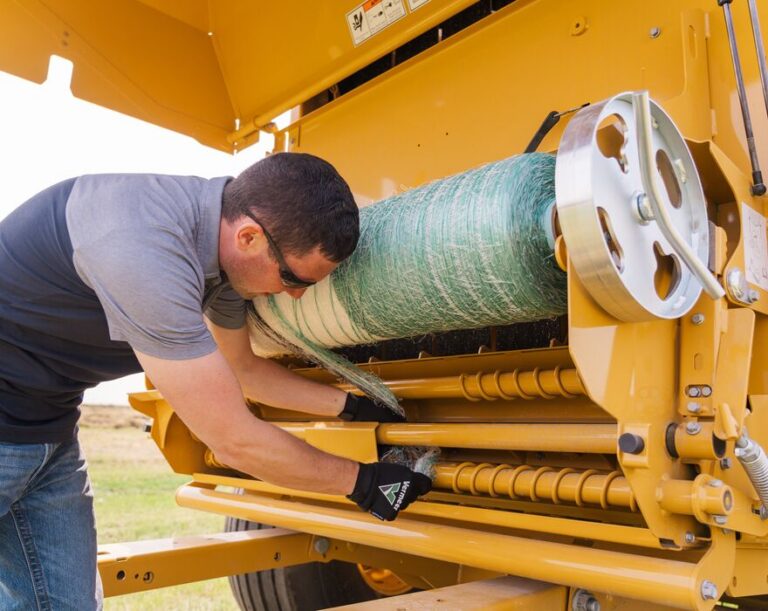
Recker said that “getting your netwrap dialed in” is one of the most important parts of setting up your baler.
Netwrap performance starts with:
- Using high-quality netwrap, such as Vermeer Net
- Routing the net correctly, as shown on the decal located on the baler
- Verifying brake and tension settings
- Monitoring net spread on completed bales
“Net tension overall is going to be your biggest thing that can make or break whether or not you are making good-looking bales,” Recker said.
Start with the recommended net tension setting
The 604 S-series balers include a recommended starting point for net tension. Operators can then make adjustments based on field performance and bale appearance.
If the net starts feeding immediately, tension may be too low. If netwrap struggles to start during the wrapping cycle, tension may be too high. Checking how clean a cut there is on the netwrap can also be an indication of net tension. Recker recommends adjusting tension incrementally until net spread and startup performance are optimized.
Check your net spread
After making a few bales, get out and inspect them.
A properly wrapped bale should have consistent coverage and strong edge-to-edge net spread, helping maintain bale shape during storage and transportation.
“If you’re getting netwrap over the edge, that’s going to be a pretty good indicator that you have really good net tension,” Recker said.
A netwrap loading tip
For operators using Vermeer Net, Recker has a tip for loading it correctly.
“Vermeer netwrap is black, white and green,” Recker said. “My trick with that, is that black has an L in it, so it goes on the left side of the baler; green has an R in it, so it goes on the right side of the baler.”
Following this simple method can help confirm the direction of the netwrap when you initially put the roll in.
What density setting should you start with on a new baler?
When breaking in a new machine, maximum density isn’t always the best starting point.
“A lot of times when starting balers, we like to start it at 65, 70% density,” Recker said.
He recommends making 5 to 10 bales at that setting before evaluating performance and appearance. If additional density is desired, operators can gradually increase settings from there.
For operators running a 604S Premium baler, density can be adjusted beyond 100%.
That additional density can help:
- Increase bale weight
- Improve stackability
- Help maintain bale shape
- Maximize payloads when transporting hay
How can proper windrow management improve bale shape?
Baler setup doesn’t stop at the machine itself. Windrow size also plays a major role in bale quality.
“You want to make sure you have enough crop on the outside of the windrow to pack the edges so you get the nice square shoulders that you’re looking for,” Recker said.
Windrows that are too narrow can make it difficult to fill the bale chamber evenly. Windrows that are too wide can contribute to poor bale formation.
Proper windrow sizing can help create:
- Squared shoulders
- Uniform density
- Consistent bale shape
- Improved feeding performance
For specific recommendations, consult your operator’s manual and adjust based on crop conditions.
What makes the camless pickup different on the 604S round balers?
All 604 S-series balers feature a camless pickup design. Recker noted that Vermeer has spent years refining this design for crop versatility and long-term durability.
The pickup is designed to handle a wide range of crop conditions while helping reduce maintenance requirements.
“There are only two bearings on the whole pickup,” Recker said. That means decreased wear points on the baler.
Additional benefits include:
- Reduced wear-part count
- Low maintenance requirements
- Heavy-duty pickup components
- 3-year pickup warranty
Why do bale shape and net spread matter?
For many producers in regions where 6×4 bales are common, bale appearance isn’t just cosmetic.
“A lot of them are transporting or selling their bales,” Recker said. “They want really good net appearance and they want heavy bales.”
As a result, bale density, shape and net appearance become important factors.
The 604 S-series platform was developed with an emphasis on:
- Sharp bale corners
- Smooth sidewalls
- Consistent bale density
- Improved net spread
- Transportation-friendly bales
Recker noted that dense, well-formed bales typically stack better, transport more efficiently and help maintain their appearance throughout handling and storage.
How can you get the most from your baler belts?
The belts used on 604 S-series balers were designed with durability and longevity in mind.
“We have grade A rubber on them that has more resilience and better puncture resistance on them, so that they can last longer and bale more bales before you wear out the texture,” Recker said.
While belt design plays an important role in durability, routine inspections can help operators get the most from their baler. Recker recommends periodically checking belt tracking to ensure belts are running properly between the guides and making any adjustments outlined in the operator’s manual if needed. He also recommends inspecting belt lace pins regularly and replacing them as part of annual maintenance or whenever excessive wear is observed.
What technology features make baling easier?
The 604 S-series lineup includes technologies designed to help you monitor bale quality and make adjustments from the cab. These features simplify the operation, not complicate it.
Standard on all 604 S-series balers:
- Atlas Pro™ control system
- Bale shape indicators
- In-cab density adjustment
Available on select models or as options:
- Scales (optional on all models)
- Net lift system (optional on all models)
- Auto Lube greasing system (standard on Premium; optional on Rancher and Signature)
- Additional automation features available on Premium
For operators focused on consistency, these tools can help monitor bale weight, moisture and density while reducing the need for trial-and-error adjustments throughout the day. As Recker noted, moisture readings, bale weights and in-cab density adjustments can be used together to help dial in bale quality as conditions change.
Consistent bale quality starts before the first bale
The best-performing balers aren’t necessarily the ones making the most bales per hour — they’re the ones that are properly prepared before entering the field.
By taking time to verify tractor connections, inspect critical wear components, dial in net tension, adjust density settings and evaluate bale appearance, operators can help set themselves up for a productive season with their 604 S-series balers.
If you need help with baler setup, density adjustments or optimizing performance for your crop conditions, contact your local Vermeer dealer for support.
Vermeer Corporation reserves the right to make changes in engineering, design and specifications; add improvements; or discontinue manufacturing at any time without notice or obligation.
Equipment shown is for illustrative purposes only and may display optional accessories or components specific to their global region.
Please contact your local Vermeer dealer for more information on machine specifications.
Vermeer, the Vermeer logo, Equipped to Do More, Atlas Pro and the Black, White, Green bale wrap color scheme (Vermeer Net) are trademarks of Vermeer Manufacturing Company in the U.S. and/or other countries.
© 2026 Vermeer Corporation. All Rights Reserved.